

5 Signs Your Factory Audit Process Needs Improvement
You just finished another grueling factory audit. The binder is thick, the checklist is fully ticked and the corrective action plan (CAP) is attached. But six months later, the same safety violation reappears. The same packaging error slips through. The same overtime issues crawl back into the production schedule.
Does this sound familiar?
If it does, your factory audit process is stuck and needs improvement. In the world of global supply chains, an inefficient audit process creates blind spots that lead to product recalls and broken supplier relationships.
Let’s stop pretending. Let’s ask the hard questions. Here are the five signs that your factory audit process needs urgent improvement framed as questions you must answer honestly.
1. Are You Auditing the Same Non-Conformances Every Single Quarter?
Walk into almost any factory that has been on your supplier roster for more than a year. Ask to see the last three audit reports. I guarantee you will see a pattern: Repeat Non-Conformance (RNC).
Here is a real example. A textile factory in Bangladesh fails its social compliance audit for excessive overtime (more than 60 hours per week). The audit report notes it. The supplier promises to fix it. Three months later, the next audit finds the exact same overtime violation. The corrective action? Another promise. Another training log. Another signature.
Why This Happens
Most audit processes are designed to detect defects, not to correct systemic issues. Your audit team might be excellent at finding problems but terrible at verifying that the solutions actually work. When you see the same NC (non-conformance) across three consecutive audits, you are not auditing continuous improvement. You are auditing theater.
What Improved Looks Like
- Root cause analysis (RCA) is mandatory before closing any major non-conformance.
- Verification audits happen as unannounced spot-checks within 30 days, not 6 months.
- Trend data is tracked per supplier and three-time repeat offenders trigger automatic probation.
Ask yourself: Does my current audit process have a mechanism to prevent déjà vu? If not, that is sign number one.
2. Is Your Audit Checklist Longer Than Your Supplier’s Attention Span?
I have seen factory audit checklists with 487 line items. Four hundred and eighty-seven. They cover everything from fire extinguisher pressure gauges to the fluoride content of cafeteria drinking water. At some point, a very earnest quality manager decided that more questions equal more safety.
It does not.
The Law of Diminishing Audit Returns
When your checklist is a monster, two things happen:
- 1. Auditors rush. They skip deep investigation to finish before the factory closes for lunch.
- 2. Suppliers disengage. They stop seeing the audit as a partnership and start seeing it as a tax.
The result? A "tick-box audit." The auditor observes that the fire extinguisher is present (tick). But they never check if the staff actually knows how to use it. They confirm that the scale is calibrated (tick) but never watch a production operator use it incorrectly.
What Improved Looks Like
Lean auditing. A focused, risk-based checklist with 20–30 critical control points instead of 500 minor observations. The best audit processes ask:
- What are the top five risks in this specific factory (based on product type, machinery age, turnover rate)?
- Which 20% of checklist items predict 80% of all past failures?
- Can we remove ten items this quarter without increasing risk?
Ask yourself: Would I rather have a perfect checklist or a perfect understanding of the factory’s real dangers? If you chose the checklist, your process needs improvement.
Read more: 7 Types of Factory Audits that Help to Evaluate Your Supplier
3. Do Your Corrective Action Plans (CAPs) Take Longer to Write Than to Execute?
Here is a sad truth I have observed across dozens of supply chains: The average factory audit spends 80% of its energy on finding problems and 20% on solving them. Sometimes even less.
A CAP (Corrective Action Plan) becomes a bureaucratic exercise. The auditor writes: "Training will be conducted." The factory manager writes: "Training completed on date X." The quality director signs off. Everyone moves on.
But was the training effective? Did the trainee understand? Did the new behavior stick for more than two weeks?
The "Root Cause" Illusion
Many audit processes ask for a root cause, but they accept shallow answers. Example: Why did the metal detector fail? "Operator error." That is not a root cause. That is blame. A real root cause would be: "The operator was not given a refresher after his 3-week vacation and the standard work instruction was only posted in English, although 40% of line workers read Bengali."
When you accept shallow root causes, your CAPs are destined to fail. And because they fail, the next audit finds the same problem. And that means… more CAP writing.
What Improved Looks Like
- 5-Why analysis is mandatory for any major or repeat non-conformance.
- CAP effectiveness review is a separate step, scheduled 60 days after closure, conducted by a different auditor if possible.
- Time-to-close metrics are tracked. If a CAP takes longer than 90 days, it triggers an executive review.
Ask yourself: Does my team spend more time documenting problems or verifying that problems have truly disappeared forever? Be honest.
Read more: SLCP Audit: A Smarter Path to Social Compliance and Factory Transparency
4. Are Your Factory Audits Causing (Not Preventing) Ethical Violations?
This is the most uncomfortable question. But we have to ask it. Can your audit process actually create the very problems it claims to solve?
Yes. In fact, it happens all the time, especially in social compliance and labor audits.
The "Audit Tourist" Problem
Imagine you are a factory manager in a high-pressure apparel hub. You know the buyer’s audit team is arriving next Tuesday. You also know that a surprise investigation would find 20 young workers on the night shift without proper contracts.
What do you do? You hide them. You scrub the attendance records. You ask those workers to stay home (without pay) for the audit day. You create a "show floor" that looks perfect for exactly four hours.
Congratulations. The audit process just incentivized:
- Unauthorized subcontracting (moving risky production to un-audited satellite units)
- Wage theft (those hidden workers lose a day’s pay)
- Falsified documentation
This is called the "audit effect." The more predictable, announced and checklist-driven your audit process, the more skilled suppliers become at masking non-compliance.
What Improved Looks Like
- Unannounced audits (or semi-announced with a 4-hour window).
- Worker interviews away from management – real, private, confidential.
- Data triangulation – comparing payroll records, timecards and security badge swipes to find discrepancies.
- Consequence modeling – before each audit cycle, ask: What behavior does this audit incentivize?
Ask yourself: Is my audit process catching hidden problems or is it teaching suppliers how to hide them better? If you suspect the latter, stop and redesign.
Read more: Unveiling the Power of Worker Safety and Social Audit
5. Are You Measuring Audit "Activity" Instead of Audit "Outcomes"?
Here is a classic sign of a broken process. You celebrate that your team completed 150 factory audits this year. You put a graph on the wall showing that audit completion rates are up 15%.
But no one asks: Did the factory get safer? Did quality defects drop? Did on-time delivery improve?
The Vanity Metric Trap
Audit counts, report pages written, CAPs closed are activity metrics. They feel good. They give you something to report to the C-suite. But they are dangerously decoupled from reality and hence are termed as the vanity metrics.
Imagine an audit process that closes 100% of its CAPs within 30 days. Sounds amazing, right? Not if the CAPs are all trivial ("replace torn poster on safety board") while a major electrical hazard goes unaddressed because it will take 90 days to rewire.
Similarly, you can complete 200 audits and still have a supplier disaster if those audits never once looked at the real risk: an overworked quality manager who has been falsifying test results for two years.
What Improved Looks Like
Outcome metrics:
- First-pass yield of audited factories vs. non-audited (lagging indicator)
- Severity-weighted non-conformance rate (a major structural issue counts more than a missing poster)
- Supplier audit score correlation with actual product quality data from incoming inspection
- Time to recurrence – how many days before the same NC reappears?
Ask yourself: If I stopped reporting audit completion rates tomorrow, would anyone miss them? If yes, because they care about results, fine. If they would miss the sheer count, you have a problem.
Read more: What is Environmental Management Audit?
How to Fix It (Without Throwing Out Everything)
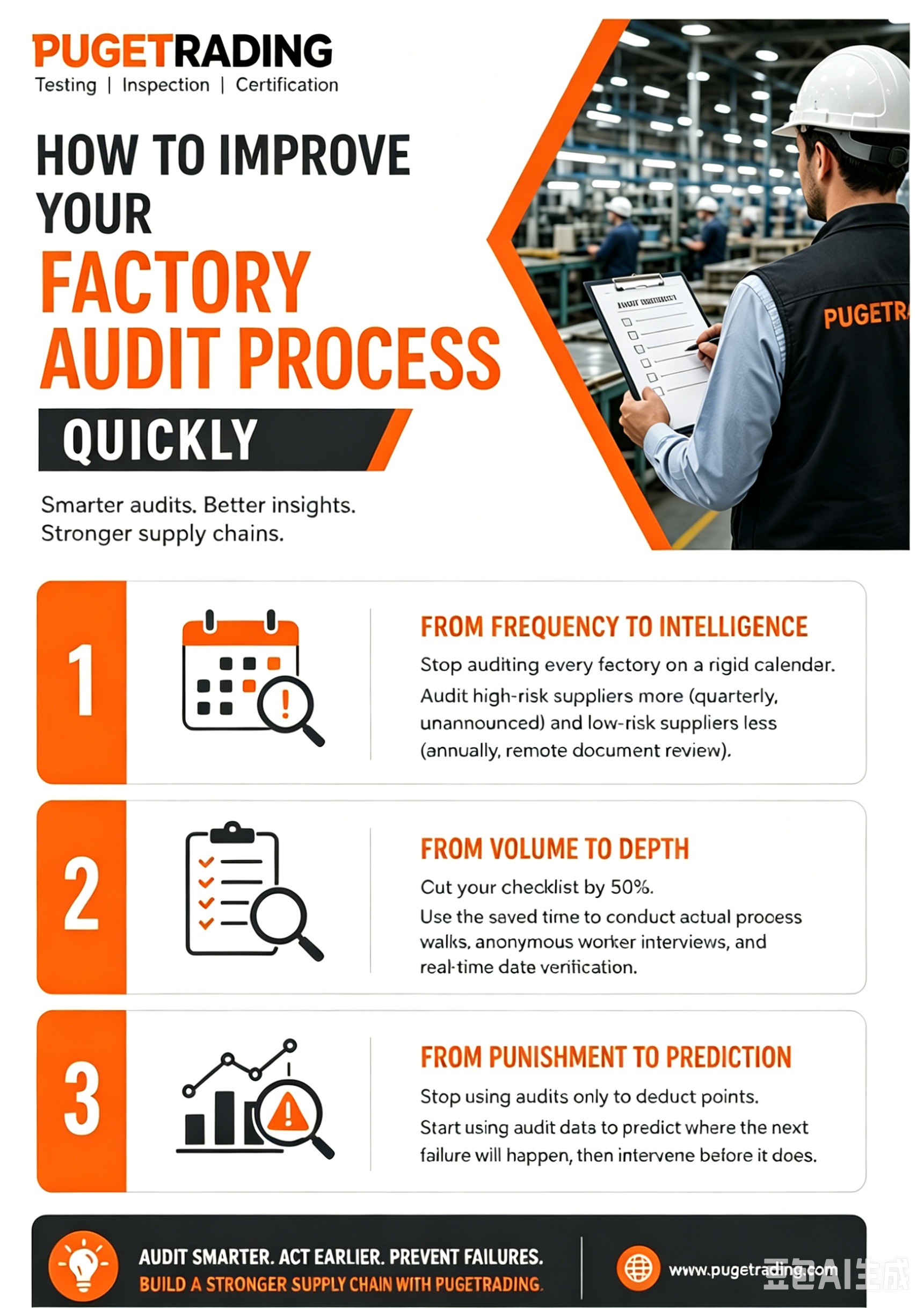
You do not need to scrap your entire factory audit process. But you do need to make three immediate shifts:
- From frequency to intelligence. Stop auditing every factory on a rigid calendar. Audit high-risk suppliers more (quarterly, unannounced) and low-risk suppliers less (annually, remote document review).
- From volume to depth. Cut your checklist by 50%. Use the saved time to conduct actual process walks, anonymous worker interviews and real-time data verification.
- From punishment to prediction. Stop using audits only to deduct points. Start using audit data to predict where the next failure will happen, then intervene before it does.
And one more thing: talk to your factory managers. Ask them what they hate about your audit process. Their answers will be more honest than any report.
Frequently Asked Questions (FAQ)
1. How often should we really audit a factory that has passed three audits in a row?
Answer: It depends on risk, but generally, you can reduce frequency. A "low-risk, high-performing" factory might move from quarterly to semi-annual or even annual audits. However, do not eliminate audits entirely. Instead, replace some full audits with lighter "touchpoint reviews" (video calls, document uploads) and keep the door open for unannounced spot-checks. Complacency is the enemy.
2. What is the single biggest waste of time in most factory audits?
Answer: The opening meeting and the closing meeting, when done ritualistically. Many audits waste 2–3 hours on lengthy presentations, reviewing the same ISO certificates and reading the checklist aloud. A better approach: send the checklist in advance, skip the slide show and start walking the floor within 15 minutes. For the closing meeting, only discuss critical findings and immediate next steps.
3. Can technology fix a broken audit process?
Answer: Technology amplifies whatever process you already have. If your process is broken (shallow root causes, tick-box thinking), software will just give you faster broken audits. However, the right tools help: mobile audit apps with offline capability, photo geotagging and real-time CAP tracking. But fix the methodology first. Then automate.
4. My suppliers say they have "audit fatigue" from different buyers. What can we do?
Answer: Join or create a shared audit program. Initiatives like SMETA (Sedex), SLCP (Social & Labor Convergence Program) or industry-specific mutual recognition agreements allow one audit to serve multiple buyers. If that is not possible, accept a supplier’s recent audit report from another credible buyer and conduct only a gap assessment or remote verification. Audit fatigue leads to fake cooperation and hidden risks.
5. What is the best question to ask a factory worker to test if our audit process works?
Answer: Ask a line worker (privately, with no manager present): "If a safety or quality problem happened right now, would you feel safe stopping the line and reporting it without fear of punishment?" If they hesitate, say "maybe," or laugh nervously, your audit process has failed to build a true speaking-up culture. That is more telling than any checklist.
Partner with Pugetrading for your Factory Audits
Your factory audit process is a living system. And like any system, it drifts toward inefficiency and theater if you do not actively fight back.
The five signs we covered – repeat non-conformances, bloated checklists, ineffective CAPs, unintended ethical harm and vanity metrics are not failures of effort. They are failures of design.
At , we send independent third-party auditor to your supplier’s manufacturing facilities to objectively evaluate core objectives of safety, security, ethical operations, compliance of government regulations, adherence to your company’s standards and to avoid costly supply chain interruptions.
If you’re thinking about auditing a supplier, feel free to reach out to discuss with us.
 During Production Inspection i
 Thailand Burn-Free Maize Regul
 OCS Certification Explained: R
5 Signs Your Factory Audit Pro
OCS Certification Explained: R
5 Signs Your Factory Audit Pro
Leave us a message
24-hour online customer service at any time to respond, so that you worry!